A washing machine that won't power on, trips your circuit breaker, or resets itself mid-cycle has a power fault - and diagnosing it correctly matters, because several unrelated problems (a blown fuse, a tripped door interlock, a genuine control-board failure, even a power surge from elsewhere in the home) can produce near-identical symptoms. The control board (PCB) sits at the centre of most of these faults, since it manages every cycle, reads every sensor, and controls every motor and valve - but not every power fault is a board replacement, and getting the diagnosis right first saves paying for a part you didn't need.
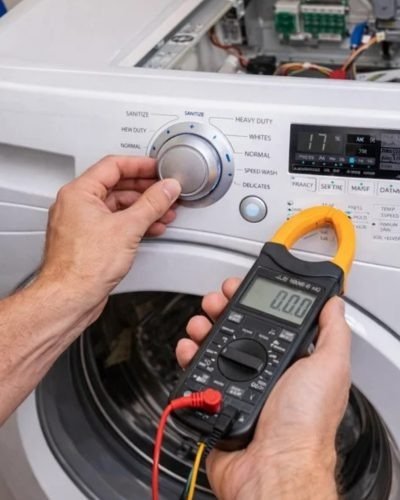
A voltage spike - common during UAE's summer storm season or from building-wide electrical fluctuations - can damage board components instantly.
Condensation or a slow leak near the board compartment gradually corrodes connections until a component fails.
Often the cheapest and fastest PCB-related fix - one relay fails while the rest of the board remains functional, and it can be repaired without a full board replacement.
On some models, heavy detergent residue on internal contacts can cause stalling or inconsistent cycle behaviour that looks electronic but resolves with a maintenance clean.
Less common, but after years of cumulative wear or a serious surge, the board can fail completely and require full replacement.
Call a technician when: the machine won't power on at all, resets itself mid-cycle, mixes up which programme is running, or shows multiple unrelated error codes in sequence - all of these point to the control board rather than a single mechanical part, and need proper diagnostic testing rather than guesswork.
Both brands' boards are generally reliable, but when they do fail it's more often a single relay or surge-damaged component than the entire board, which keeps repair costs down relative to a full replacement.
Board-level repairs on these models should use genuine or OEM-equivalent components - the precision tolerances mean generic substitutes are a more frequent cause of repeat faults here than on other brands.
On older semi-automatic and budget machines, a suspected "PCB fault" is more often a simpler mechanical timer issue, since many of these models use fewer electronic components than premium automatic machines.
Where power fault repair actually falls on the risk-and-effort scale, compared to the alternatives.
| DIY | Professional Repair | Full Replacement | |
|---|---|---|---|
| Best for | Only the basic checks listed above | Confirmed power fault repair faults needing parts or disassembly | Older machines with repeated, unrelated faults |
| Difficulty | Low, if limited to the checks above | N/A — handled by a trained technician | N/A — logistics only |
| Risk level | Low for basic checks; high if you go further without training | Low — diagnosed and warrantied | None (new unit) |
| Time to resolve | Minutes, if the cause is simple | Usually same-day, single visit | 1-3 days (ordering, delivery, install) |
| Recommended for | Confident homeowners tackling the safe checks only | Anyone with a confirmed mechanical, water or electrical fault | Machines already past typical service life |
A fair quote always follows a free or low-cost diagnosis, is confirmed before any work begins, and is backed by a 90-day warranty on parts and labour.
A simple gut-check: if repair cost is under roughly 30-40% of a new equivalent machine and the unit is under 7 years old, repair is almost always the better call.
If the machine won't power on at all, resets itself, or shows several unrelated error codes, that points to the control board. If it's a single specific code that's consistent every time, it's more likely a sensor or component the board is correctly reporting on.
Not necessarily - a single burnt relay is a comparatively fast, inexpensive fix, since it doesn't require replacing the whole board. Cost depends entirely on whether one component failed or the board needs full replacement, which only a proper diagnosis can determine.
Yes - voltage spikes, particularly during UAE's summer storm season, are a genuine and fairly common cause of board damage, which is one reason a surge protector on major appliances is worth considering.
Inconsistent behaviour on an identical cycle setting is a classic sign of a board-level issue rather than a mechanical one - mechanical faults tend to be consistent, while electronic faults often aren't.
A single power-cycle (unplug for 60 seconds) is safe to try and occasionally clears a minor glitch. If the machine still won't power on afterwards, further troubleshooting involves opening the unit, which isn't a DIY-safe step.
No - repeated tripping is the machine signalling a genuine electrical fault, not a random nuisance trip. Continuing to reset and reuse it risks further damage to the board or, in rarer cases, a safety hazard.
No - many power faults are a single failed relay, a blown fuse, or even a tripped door interlock rather than the full board. A proper diagnosis identifies which component actually failed before any part is ordered.
Yes - voltage fluctuations, particularly during the summer storm season, are a recognised cause of appliance board damage across the region, which is why a surge protector on major appliances is a reasonable precaution.
We offer power fault repair in 190+ neighbourhoods across all three emirates — from Downtown Dubai and Dubai Marina to Al Nahda Sharjah and Ajman Downtown — with the same upfront pricing, genuine parts and 90-day warranty everywhere we go.
Most power fault repair faults trace back to a small, well-understood set of causes rather than a mystery problem, which is why a correct diagnosis on the first visit matters more than anything else in keeping the repair fast and affordable. If your machine is otherwise reliable and under 6-7 years old, repair is almost always the right call; if this is one of several recent faults on an older unit, it's worth weighing that against a replacement using the framework above. Either way, describing the exact symptom — when it happens, what you hear or see, and any code on the display — is the single biggest thing you can do to speed up your visit.